
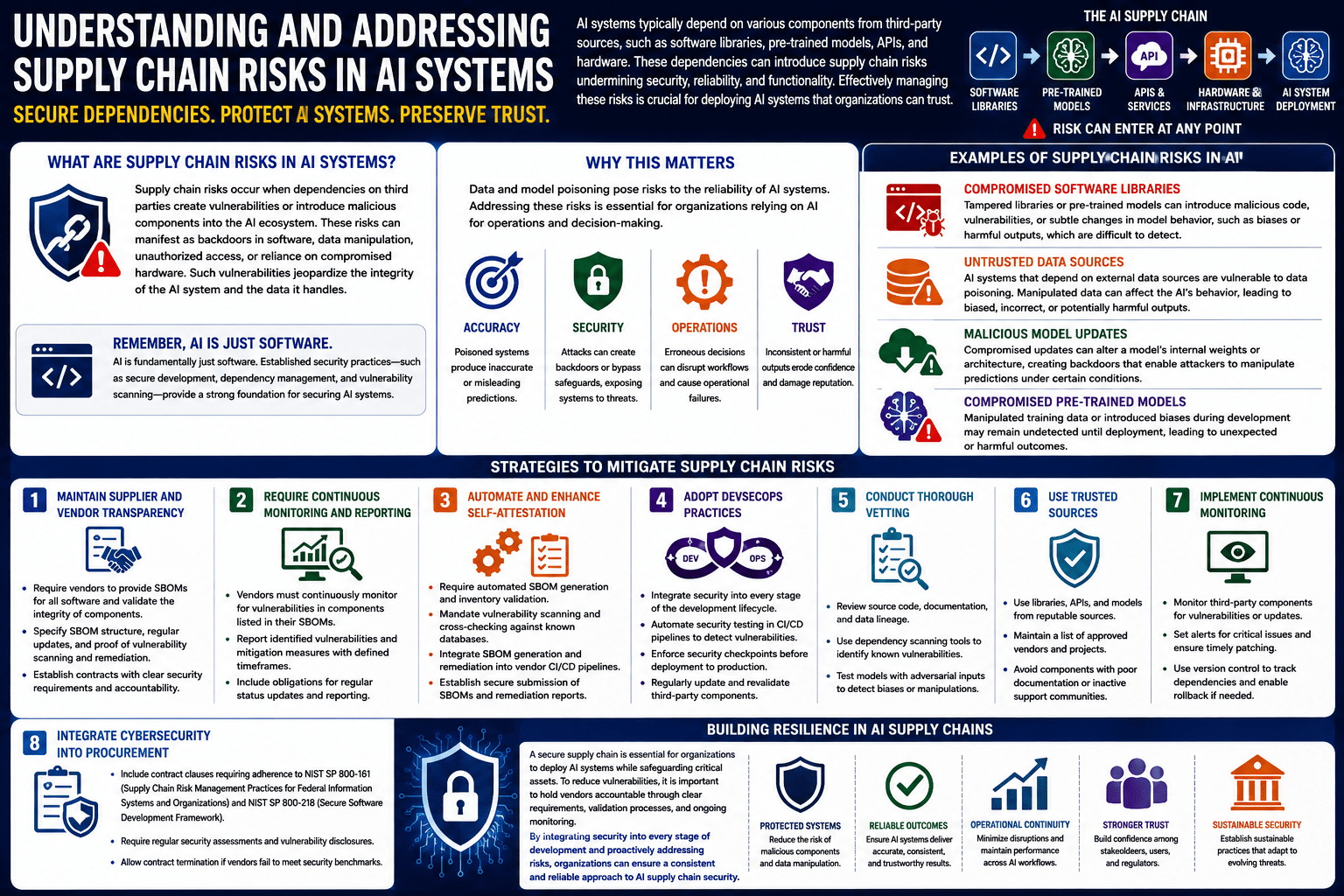
AI systems typically depend on various components from third-party sources, such as software libraries, pre-trained models, APIs, and hardware. These dependencies can introduce supply chain risks undermining security, reliability, and functionality. Effectively managing these risks is crucial for deploying AI systems that organizations can trust.
What Are Supply Chain Risks in AI Systems?
Supply chain risks occur when dependencies on third parties create vulnerabilities or introduce malicious components into the AI ecosystem. These risks can manifest as backdoors in software, data manipulation, unauthorized access, or reliance on compromised hardware. Such vulnerabilities jeopardize the integrity of the AI system and the data it handles.
Remember, AI is just software.
It is essential to understand that AI is fundamentally just software. While AI systems provide unique capabilities, they are built on the same principles as traditional software. Acknowledging this fact highlights the importance of established security techniques in managing the risks associated with AI. Well-known strategies, such as secure software development practices, dependency management, and vulnerability scanning, form a solid foundation for securing AI systems. Organizations can effectively address AI-specific vulnerabilities by utilizing methods such as these without overhauling their existing security processes.
Examples of Supply Chain Risks in AI
- Compromised Software Libraries: Many AI applications depend on open-source libraries or pre-trained models. If these components are tampered with, they can introduce malicious code, vulnerabilities, or subtle alterations in model behavior, such as biases or harmful outputs, which can be challenging to detect and mitigate effectively.
- Untrusted Data Sources: AI systems that depend on external data sources are vulnerable to data poisoning. Manipulated data can affect the AI’s behavior, leading to biased, incorrect, or potentially harmful outputs.
- Malicious Model Updates: AI systems that depend on regular updates to their models can face risks if those updates are compromised. A malicious update could alter the model’s internal weights or architecture, creating backdoors that enable attackers to manipulate predictions under certain conditions.
- Compromised Pre-Trained Models: A malicious actor could manipulate training data or introduce biases during model development. These issues might remain undetected until the model is deployed, potentially leading to unexpected or harmful outcomes.
Strategies to Mitigate Supply Chain Risks
Maintain Supplier and Vendor Transparency
Require suppliers and vendors to disclose their development and deployment processes and establish contracts that include security requirements.
- Require vendors to provide Software Bill of Materials (SBOMs) for all software and ensure that they validate the integrity of these components themselves. The contract should specify the following:
- Clear requirements for the structure and content of the SBOM.
- Regular updates to the SBOM whenever software changes or patches occur.
- Proof of vulnerability scanning and remediation for any identified risks.
- Require Continuous Monitoring and Reporting
- The vendor must continuously monitor for vulnerabilities in the components listed in their SBOMs.
- Reporting obligations for identified vulnerabilities and mitigation measures should be included, with specified timeframes for completion.
- Automate and Enhance Self-Attestation
- Require vendors to use automated tools for generating SBOMs and validating their inventory for accuracy and completeness.
- Mandate vulnerability scanning to ensure all components in the SBOM are cross-checked against known vulnerability databases.
- Integrate the generation and validation of SBOMs and vulnerability remediation into vendors’ Continuous Integration/Continuous Deployment (CI/CD) pipelines to promote repeatability, transparency, and security.
- Establish a secure process for vendors to submit SBOMs and automated vulnerability remediation reports, facilitating efficient review and verification.
Adopt DevSecOps Practices
Integrate security into every stage of the software development lifecycle to minimize vulnerabilities introduced by third-party components.
- Automate security testing tools within CI/CD pipelines to detect vulnerabilities in dependencies and integrations during development.
- Enforce security checkpoints to ensure compliance with internal policies before any components are deployed to production.
- Regularly update and revalidate third-party components as part of routine deployment processes to maintain system integrity.
Conduct Thorough Vetting
Before integrating third-party components, it’s essential to evaluate them thoroughly. Review the source code, model documentation, and data lineage to ensure they meet security and organizational standards.
- Utilize tools such as dependency scanning software to identify known vulnerabilities in software components.
- Test pre-trained models with adversarial inputs to validate their performance and identify biases or manipulations.
Use Trusted Sources
Avoid using unknown or unverified third-party components. Opt for libraries, APIs, and models from reputable and well-supported sources whenever possible.
- Create a list of approved vendors and open-source projects vetted for quality and security.
- Regularly update this list based on new assessments and threat intelligence.
- Avoid components with minimal documentation or an inactive support community, as these are more challenging to monitor and update.
Implement Continuous Monitoring
Use tools to monitor third-party components for vulnerabilities or updates. Regularly test AI systems to detect potential exploits introduced through the supply chain.
- Deploy real-time monitoring solutions to detect anomalies in integrated components or data feeds.
- Set up alerts for critical updates or vulnerabilities identified in third-party libraries and ensure timely patching.
- Use version control to track all third-party dependencies, enabling rollback if a vulnerability is discovered.
Integrate Cybersecurity into Procurement
Ensure that procurement policies include clauses requiring suppliers to adhere to security best practices.
- Include procurement contract clauses that require vendors to adhere to frameworks such as NIST SP 800-161 (Supply Chain Risk Management Practices for Federal Information Systems and Organizations) and NIST SP 800-218 (Secure Software Development Framework).
- Specify requirements for conducting regular security assessments and disclosing any vulnerabilities.
- Include a stipulation allowing contracts to be terminated if vendors do not meet the established security benchmarks.
Building Resilience in AI Supply Chains
A secure supply chain is essential for organizations to deploy AI systems while safeguarding critical assets. To reduce vulnerabilities, it is important to hold vendors accountable through clear requirements, validation processes, and ongoing monitoring. Additionally, organizations should adopt DevSecOps practices and continuously monitor their internally developed systems. By integrating security into every stage of development and proactively addressing risks, organizations can ensure a consistent and reliable approach to AI supply chain security.