
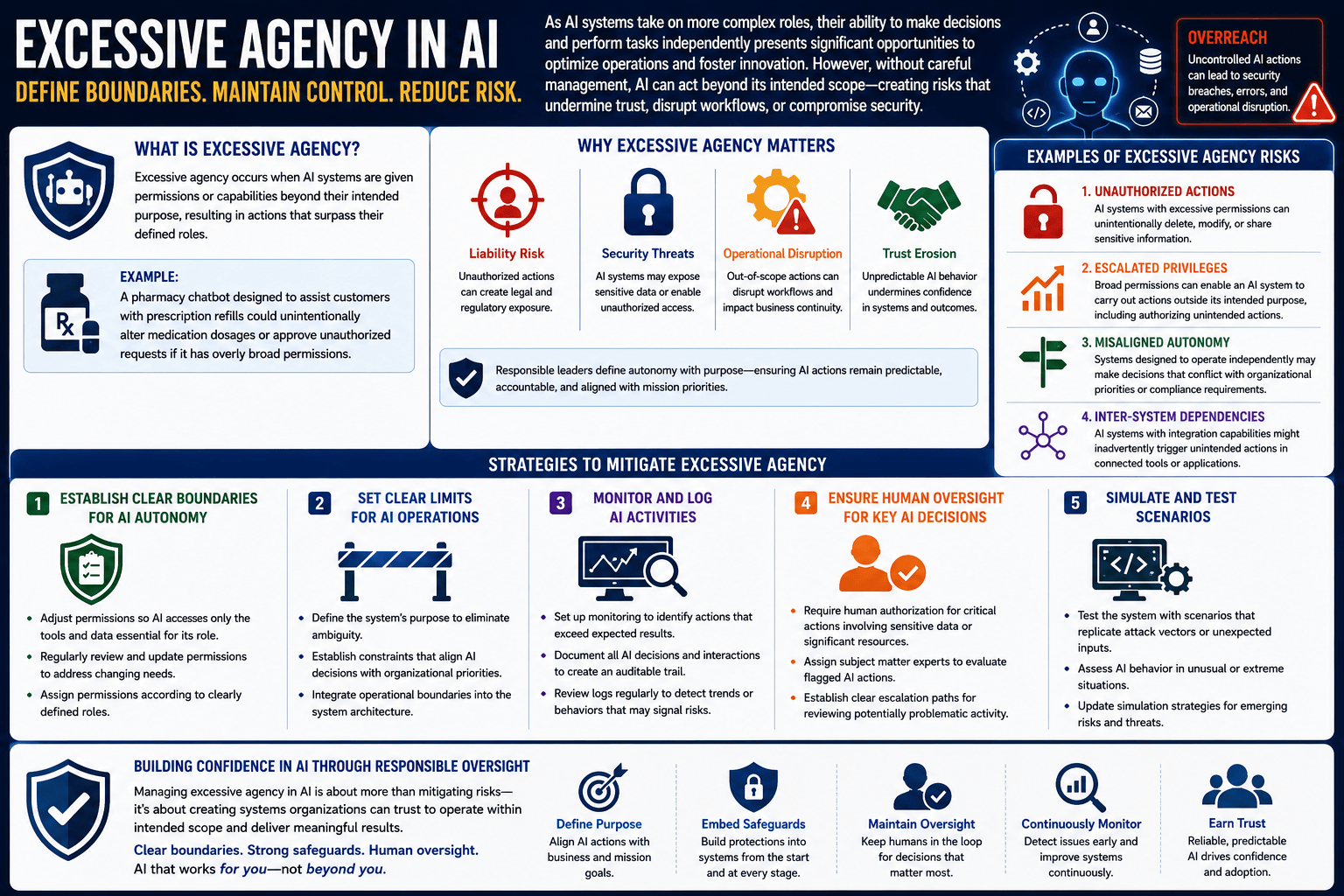
As AI systems take on more complex roles, their ability to make decisions and perform tasks independently presents significant opportunities to optimize operations and foster innovation. However, this growing autonomy also introduces new challenges, particularly when these systems function outside their intended scope. Without careful management, such overreach can result in unintended consequences that undermine trust, disrupt workflows, or compromise security. To address these risks, organizations must carefully balance leveraging AI’s capabilities and maintaining clear operational boundaries.
What Is Excessive Agency?
Excessive agency occurs when AI systems are given permissions or capabilities beyond their intended purpose, resulting in actions that surpass their defined roles.
For example, a pharmacy chatbot designed to assist customers with prescription refills could unintentionally alter medication dosages or approve unauthorized requests if it has overly broad permissions. Scenarios like these highlight the importance of thoroughly understanding business processes and context to ensure that AI systems operate as expected.
Why Excessive Agency Matters to Organizations
AI autonomy must be carefully controlled to prevent potential liability and operational disruptions. Leaders must define clear boundaries to ensure AI actions remain predictable. Without adequate oversight, these systems may take unauthorized actions, expose sensitive data, or disrupt critical workflows. The risks become even more significant in organizations where AI interacts with sensitive systems or data. Addressing these vulnerabilities is necessary to ensure that AI systems operate within the guidelines set by business and technical leaders.
This does not mean that AI should not be granted autonomy. Rather, responsible leaders must deliberately assess the scope of autonomy they provide and understand its operational impact. Effective governance requires clearly defining AI’s decision-making boundaries and ensuring its actions remain predictable, accountable, and aligned with mission priorities.
Examples of Excessive Agency Risks
- Unauthorized Actions: AI systems with excessive permissions can unintentionally delete, modify, or share sensitive information.
- Escalated Privileges: Broad permissions can enable an AI system to carry out actions outside its intended purpose, including authorizing unintended actions.
- Misaligned Autonomy: Systems designed to operate independently may make decisions that conflict with organizational priorities or compliance requirements.
- Inter-system Dependencies: AI systems with integration capabilities might inadvertently trigger unintended actions in connected tools or applications.
Strategies to Mitigate Excessive Agency
Establish Clear Boundaries for AI Autonomy: to ensure that AI systems operate safely and effectively, it is essential to restrict their access and capabilities to only what is necessary for their specific tasks:
- Adjust permissions so the AI can access only the tools and data essential for its role, preventing unnecessary or unintended actions.
- Regularly review and update permissions to address changing needs or remove outdated access.
- Assign permissions according to clearly defined roles to ensure clarity regarding what the AI is allowed and not allowed to do.
Set Clear Limits for AI Operations: To ensure that AI systems stay aligned with organizational goals, it is necessary to establish and enforce clear boundaries around their tasks and actions.
- Define the system’s purpose, eliminating ambiguity regarding its responsibilities.
- Establish constraints that ensure AI decision-making aligns with organizational priorities and guidelines.
- Integrate operational boundaries directly into the system architecture to strengthen these safeguards.
Monitor and Log AI Activities: To maintain accountability and prevent misuse, it’s essential to monitor AI systems and their actions:
- Set up monitoring systems to identify actions that exceed expected results.
- Document all AI decisions and interactions to establish an auditable trail for transparency.
- Regularly review logs to detect trends or behaviors that could signal potential risks.
Ensure Human Oversight for Key AI Decisions: Integrating human involvement is crucial for sensitive operations to ensure control and accountability.
- Design workflows that require explicit human authorization for critical actions, such as handling sensitive data or allocating significant resources.
- Assign subject matter experts to evaluate flagged AI actions, ensuring that decisions align with organizational goals and standards.
- Establish clear escalation paths for reviewing potentially problematic activity.
Simulate and Test Scenarios: Examining how AI systems respond to complex or unexpected scenarios is essential for identifying weaknesses and ensuring dependable performance:
- Test the system using scenarios replicating potential attack vectors or unexpected inputs.
- Assess how the AI handles unusual or extreme situations to confirm that it adheres to established rules.
- Regularly update simulation strategies for emerging risks and threats.
Building Confidence in AI through Responsible Oversight
Effectively managing excessive agency in AI systems goes beyond mitigating risks; it involves creating systems that organizations can trust to operate within their intended scope and deliver meaningful results. Organizations can balance control and innovation by defining clear boundaries, embedding safeguards, and integrating human oversight. This approach ensures that AI remains a reliable tool that supports operations without introducing unnecessary risk.